What Is an Enamel Coating Production Line? A Complete Guide for Manufacturers
An in-depth technical analysis of industrial enameling processes, precision equipment, and modern automation strategies for high-performance surface finishing.
The Evolution of the Enamel Coating Production Line
The modern industrial landscape demands surfaces that can withstand extreme temperatures, chemical corrosion, and mechanical wear. This is where the enamel coating production line plays a pivotal role. Unlike traditional liquid painting or powder coating, an enamel coating involves fusing glass frit to a metal substrate at high temperatures, typically between 850 degrees Celsius and 900 degrees Celsius. This process creates a vitreous, non-porous layer that is as durable as it is aesthetically pleasing.
For manufacturers of home appliances, water heaters, and architectural panels, the transition to a fully automated enamel coating production line represents a significant leap in both product quality and operational efficiency. TIMS, a leader in the industry, has pioneered systems that integrate intelligent automation with advanced thermodynamics to deliver finishes that meet global standards such as FDA, ISO 12944, and EN 10209. In this guide, we will break down the complex stages of these production lines and explore how they are transforming industrial manufacturing.
Step 1: Advanced Pre-treatment Systems
A successful finish on an enamel coating production line begins long before the first grain of frit is applied. Pre-treatment is arguably the most critical phase, as the bond between the glass layer and the metal depends entirely on surface purity. For heavy-duty steel plates used in water heaters or industrial equipment, TIMS employs high-precision grit blasting or sandblasting equipment to remove oxidation, rust, and scale. This mechanical cleaning provides a microscopic roughness that optimizes glass adhesion (ASTM D3359 certified).
In many configurations, a chemical pre-treatment stage is also utilized. This involves alkaline degreasing, acid pickling, and nickel flashing. These steps ensure that every square millimeter of the substrate is free from oils and contaminants. In a modern enamel coating production line, these stages are fully enclosed to minimize environmental impact and protect workers from chemical exposure. By utilizing closed-loop filtration systems, water consumption is significantly reduced, aligning with modern eco-conscious manufacturing requirements.
Critical Pre-treatment Components:
- Precision Grit Blasting Modules
- Multi-stage Ultrasonic Cleaning Tanks
- Deionized Water Rinse Cycles
- High-efficiency Drying Ovens
Step 2: Precision Enamel Application Techniques
The heart of an enamel coating production line is the application booth. There are two primary methods: the wet process and the dry electrostatic process. The wet process involves spraying a liquid enamel slurry, which is excellent for complex shapes and internal surfaces like oven cavities. However, the dry electrostatic process has gained immense popularity due to its high material utilization rate and environmental benefits. In this method, positively charged enamel powder is sprayed toward a grounded workpiece, ensuring uniform coverage even on corners and edges.
TIMS integrates AI-powered thickness control into the spray booth. This system monitors the coating in real-time, maintaining a strict range between 0.2mm and 1.5mm. With hyperspectral imaging and real-time defect detection, the system can identify minute flaws before the parts enter the firing furnace. This level of precision is essential for producing high-end architectural cladding and luxury kitchen appliances where the aesthetic finish must be flawless. Furthermore, the modular design of a TIMS enamel coating production line allows for rapid color changes, significantly increasing equipment utilization for manufacturers with diverse product portfolios.
Step 3: High-Temperature Firing and Thermal Management
The transition from a fragile powder layer to a rock-hard glass finish occurs in the firing furnace. A professional enamel coating production line uses either electric or gas-fired radiant tube furnaces. The temperature must be maintained with extreme precision—usually around 850 degrees Celsius—to ensure the enamel fuses correctly without warping the metal substrate. Oven uniformity is kept within ±5 degrees Celsius, a benchmark achieved through advanced airflow design and thermal insulation.
Energy efficiency is a major concern for modern factories. TIMS has addressed this by incorporating IoT-enabled energy recovery systems. These systems capture waste heat from the exhaust and redirect it to the pre-heating zones or drying ovens. By leveraging patented technologies, such as the Enamel Furnace Roof Waste Heat Utilization System, natural gas consumption can be reduced by up to 20%. This not only lowers operational costs but also helps manufacturers meet carbon emission targets.
Enamel Coating vs. Traditional Coating Lines
When selecting a coating strategy, manufacturers often compare the enamel coating production line with powder coating or electrophoresis lines. While powder coating offers flexibility and lower initial costs, it cannot match the thermal resistance of enamel, which can withstand temperatures up to 550 degrees Celsius. Electrophoretic coating (E-coating) provides excellent corrosion resistance for automotive parts but lacks the vibrant color options and UV resistance found in architectural porcelain enamel.
A key advantage of an integrated enamel coating production line is the permanence of the finish. Enamel is chemically bonded to the metal, meaning it will not peel, fade, or scratch easily. This makes it the premier choice for public infrastructure, such as subway stations and tunnel panels, where graffiti resistance and ease of cleaning are paramount. TIMS provides turnkey solutions that help clients navigate these technological choices, ensuring the selected line perfectly matches their throughput requirements and product lifecycle goals.
Why Choose TIMS for Your Enamel Coating Production Line?
TIMS (Guangdong Tims Smart Technology Co., Ltd.) is a premier manufacturer specializing in the design and installation of complete enamel coating production line systems. With over a decade of expertise, we have pioneered "flexible production" models that allow a single line to process multiple product types—such as water heater tanks ranging from 5L to 500L—without extensive downtime. This innovation can reduce a manufacturer's initial investment by over 50%.
Our product range includes the advanced enamel production line equipment designed for appliances and architectural panels. We also specialize in high-efficiency powder coating production line systems and electrophoresis production line solutions for the automotive industry. TIMS equipment is certified by CE, ISO9001, and SGS, ensuring that your production facility meets international safety and quality benchmarks.
Global Delivery
Professional installation and commissioning services in over 30 countries.
Patented Tech
Waste heat recovery and AI imaging systems for superior ROI.
Lifetime Support
24/7 technical assistance and original spare parts supply.
Frequently Asked Questions
Q1: What materials can be processed on an enamel coating production line?
An enamel coating production line is primarily designed for low-carbon steel, cast iron, and certain types of aluminum. These materials can withstand the high firing temperatures required to fuse the glass frit to the surface. It is essential to use "enameling grade" steel to prevent defects like fish-scaling during the cooling process.
Q2: How much energy does a typical enamel coating production line consume?
Energy consumption depends on the throughput and the heating source (gas or electric). A standard high-volume enamel coating production line may consume between 50 and 5000 kW/h. However, by using TIMS's waste heat recovery technology, manufacturers can significantly lower their energy bills and reduce their environmental footprint.
Q3: Can an enamel coating production line handle different product colors?
Yes. Modern lines are equipped with quick-change powder booths that allow for rapid transitions between different enamel formulations and colors. Whether you need a glossy black for oven interiors or vibrant blues for architectural panels, the system can be adjusted with minimal downtime.
Q4: What is the average lifespan of a production line?
A well-maintained enamel coating production line from TIMS can operate efficiently for 15 to 20 years or more. Our use of high-grade stainless steel (304/316) for critical components and heat-resistant alloys for firing elements ensures long-term durability in harsh industrial environments.
Q5: How automated is a TIMS enamel coating production line?
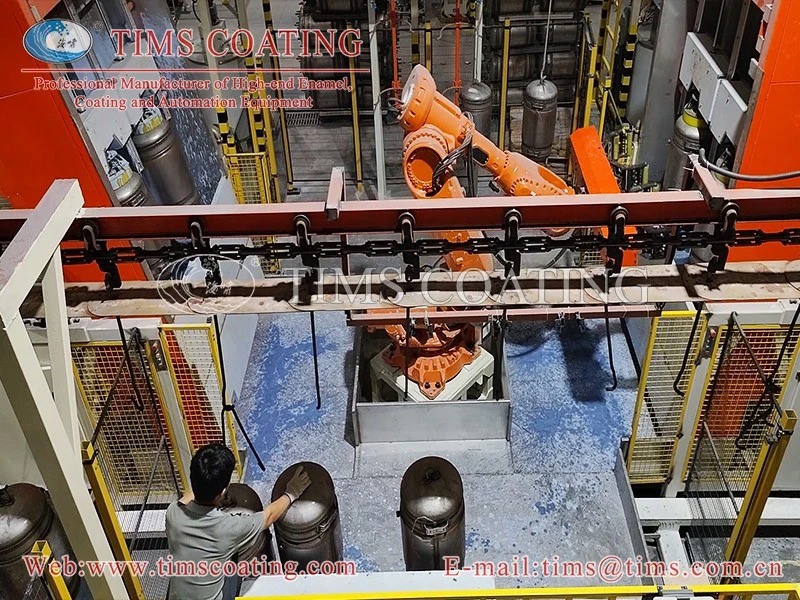
We offer fully turnkey automation. From robotic loading and unloading to AI-driven defect detection and PLC-managed firing cycles, the entire enamel coating production line can be operated with minimal manual intervention, drastically reducing labor costs and human error.
Ready to Optimize Your Production?
Whether you are building a new facility or upgrading an existing plant, TIMS provides the expertise and equipment you need to succeed in the competitive world of industrial coating. Our engineers are ready to design a custom solution tailored to your factory layout and capacity goals.